
Everyone’s obsessed with funnels.
I need a funnel.
Do I need a funnel?
How do I get a funnel?
What is my funnel?
It’s an element of marketing that’s become cloaked in mystery, like SEO or avatars. It’s easy to get sucked into needing one, or into getting FOMO about not having one when you’ve most likely got one already.
When did funnels become … well, funnels?
The invention of the original purchasing funnel concept is credited to American advertising and sales pioneer Elias St Elmo Lewis. Back in 1898 he theoretically mapped the journey of a customer from becoming aware of a product through to purchase. His simple concept is what we often now refer to as the AIDA model – an acronym which stands for Attention, Interest, Desire and Action.
Lewis suggested that for an advertisement to be successful, it should attract attention, interest the reader, create the desire for the product and stimulate action. Or in other words, funnel the reader through the distinct stages of the buying decision.
The funnel, although not then known as a funnel, was born.
Fast forward to the 21st century
Since Lewis came up with his then ground-breaking observation, the funnel has evolved. Contemporary marketing has multiple funnels; purchasing, sales, and marketing funnels … if there’s a customer journey involved, there’s a funnel for it.
Because a funnel, at its simplest, is the process of taking a prospective buyer through a series of stages until they become a customer and beyond that, an advocate for your business.
Advocates are precious. As buyers, we’re highly influenced by the opinions of others – look at how many sites now show reviews or at the rise of Trust Pilot and Reddit. Your existing customers are a powerful part of your sales team, along with your website (more about that here).
If you think about your business, you’ll have a funnel.
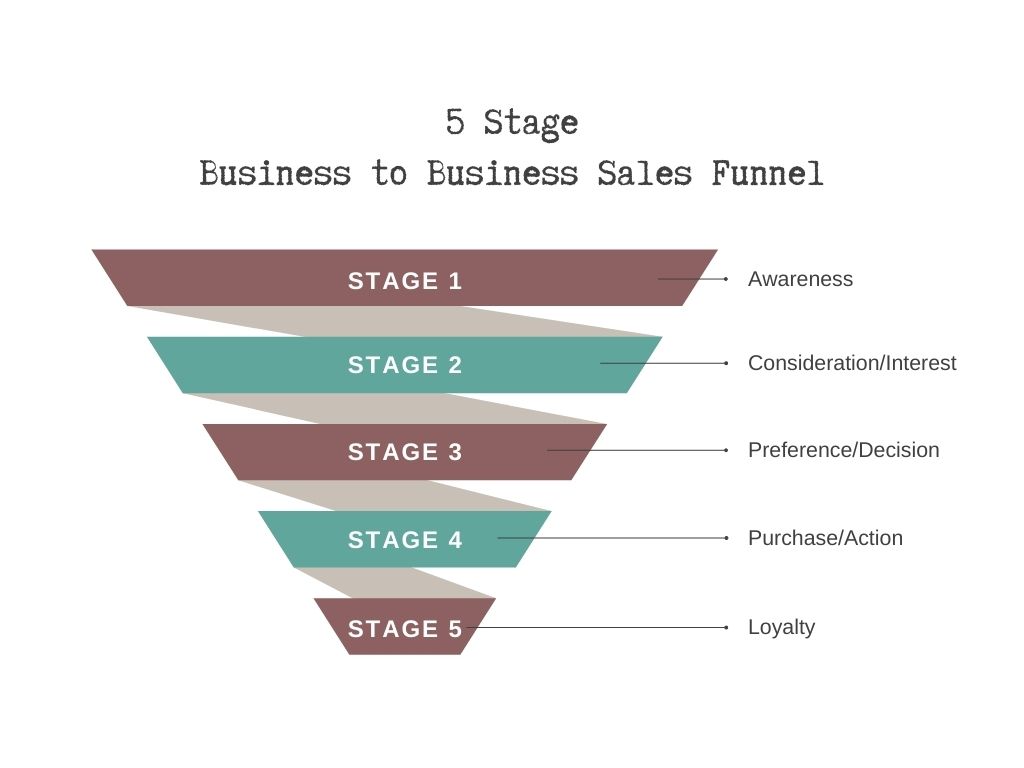
Keeping it simple
Every business is different, but the basic customer journey remains the same.
- Make people aware you exist (attention)
Where is the ‘traffic’ for what you do? Is it footfall, online, or does your business come from referrals?
How do you make people aware of what you do? This is the top of the funnel. If you’re directing traffic and you want people to stop and pay attention, how do you do it? It might be social media posting or advertising, you might have a display outside your shop or restaurant or be part of a networking group. Carefully consider what you offer and establish clearly who you are, what you do and who you do it for.
- Capture their interest and communicate in a way which identifies their needs when they’re considering options (interest)
Now you’ve got their attention, here’s where you spark their interest – and prospects are inherently selfish. They’ll want to know that you understand their needs, and they may not fully be aware of what those needs are at this stage! Help them by crafting your messages to resonate with your ideal customer. What can you do for them?
- Establish trust, and explain how your product or service should be the preferred option to solve their problem (desire)
In the middle of your funnel, your customers are considering your product or service. It’s a research phase where they may compare what you offer with your competitors. Build trust and establish your authority so that when they move to the decision phase, your company is front of mind.
- Compel them to transact with you (action)
At the bottom of your funnel, your customers are making decisions. Here, they might be tempted by an offer or sale, or by scarcity, but if you’ve done all the hard work higher up the funnel, it should be an easy choice.
- Nurture your relationship beyond the first sale so that they return for more and pass on your message to others (advocate)
Your funnel doesn’t end with the sale. Now your goal is to nurture the relationship you’ve established to encourage repeat purchases and turn your customer into an advocate for your business.
At each stage in this funnel, you can use different marketing tactics to satisfy your prospects and encourage them to the next step. You might use social media to attract attention, and then encourage them to provide their details in exchange for a freebie (also known as a lead magnet). In the next stage, you can use email marketing to build trust and tempt them with an offer to move them down your funnel. Create a loyalty programme to encourage repeat purchases or a referral scheme to reward recommendations.
Crucially, look after your customers and ask them for testimonials. If they’ve had a good experience, most people will be happy to endorse you. Litter your website with reviews and delighted customers rather than hiding them on a testimonials page. Be proud of them!
Do you need funnel software?
Sales funnel building software, such as Clickfunnels, provides a framework for guiding your prospects through the online sales process. So, a basic funnel might look something like this:
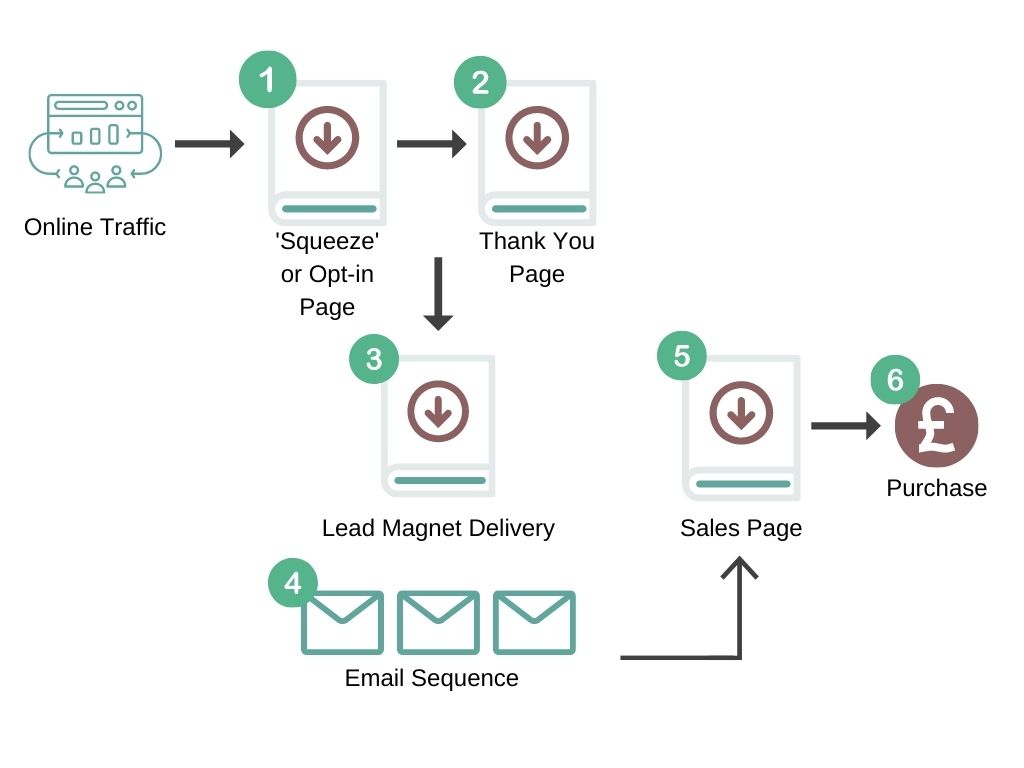
Here’s a brief explanation of each stage:
- A ‘squeeze’ page is an opt-in page where your prospect enters their details in exchange for a reward of some kind. Lead magnets can be anything of value to your audience – a report, exclusive video, a voucher, discount, or access to a secure area. We’re wise to this tactic, so make sure it’s a worthwhile exchange and that your follow-up emails give people the option of unsubscribing. You’ll always get people who subscribe to get the freebie, then unsubscribe soon afterwards. That’s fine, though. It allows you to concentrate on those who are genuine prospects and keeps your list clean.
- The thank you page is a further opportunity for you to engage your prospect. Give them something more than just a ‘thanks’. You can use this page to show an offer (leading to your sales page) or as an information page showing some of your testimonials.
- Deliver your lead magnet quickly, either online or by email. Keep your prospect interested.
- Now that you ‘own’ their data, you can craft an email sequence which nurtures your relationship. Do give them the opportunity to know, like and trust you before delivering a sales-led message.
- You’ve attracted them, you’ve sparked their interest, and now you should move them closer to the purchase.
- With online purchases, even abandoned carts are an opportunity to sell. If you have the ability to track your users, you can follow up with an email to nudge them back to the till again. You may be able to upsell or upgrade them to another product, send them a voucher or offer a free consultation call to get them over the line.
And while funnel building software makes all this easy to build and integrate, it’s not essential. Take your ad, homepage, pricing page and order page for example. You’ve got their attention with your ad and they’re interested enough by what’s on your homepage to click through to your pricing page. You’ve created enough desire for them to add something to their cart – they’ve taken action. That’s a funnel right there! No fancy software required.
The key to all of this is understanding your customers and the journey you want to take them on.
So, do you need a funnel?
Perhaps the question should be, ‘how do you create a smooth and enjoyable experience of your company, from the point of attraction through to the sale and beyond?’
One for next time.
If you need help with your marketing, please get in touch.
 Retro River
I obtained some ideas from your blog post about funnel and I will do try to apply in my journey. I wish you please make some good comments to my blog site. So that I can get more traffic to my blog. Thanks
LikeLike